
Employee IQ

Know where you are about to lose people, and what it costs.

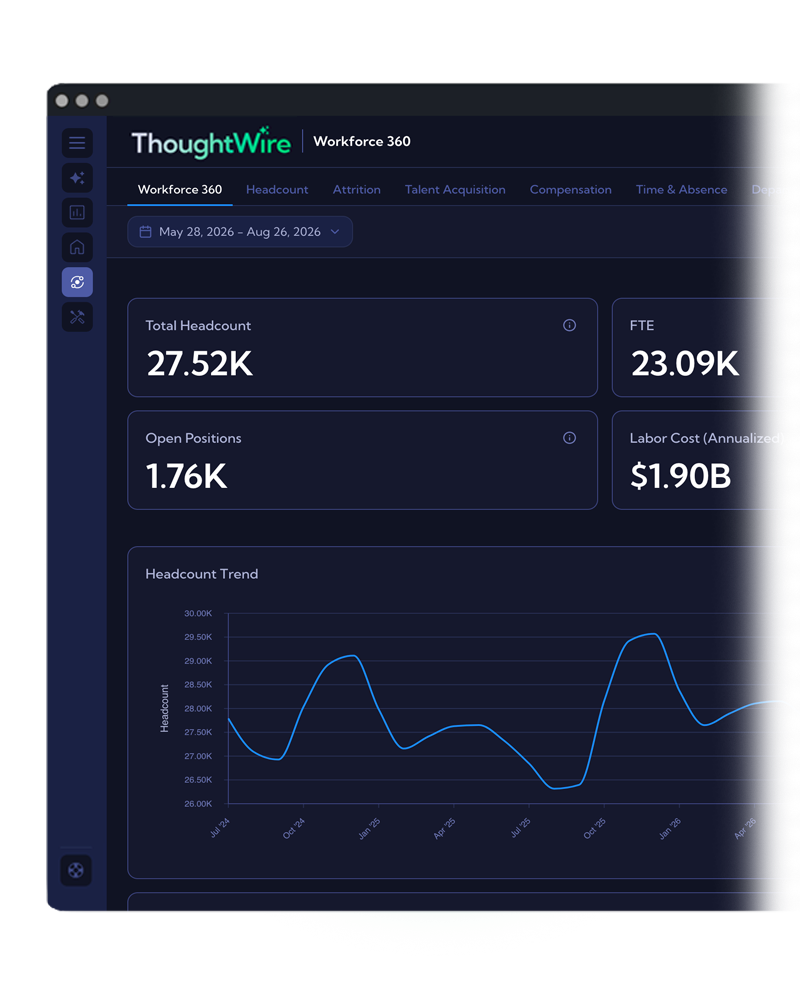
Employee IQ is ThoughtWire's workforce decision intelligence layer, built for enterprises. It is not HR reporting. Reporting tells you what your headcount was. Employee IQ tells you which workforce decision to make next, and whether it worked.

The Problem

Most enterprises have a workforce decision problem.

HR sees headcount. Finance sees labor cost. Talent acquisition sees a funnel. The line manager sees the person who resigned this morning. A department can hit its headcount plan and still be failing, once unfilled roles, above-band backfills, and unplanned overtime are counted. Counting heads hides that. Employee IQ ranks departments by workforce risk and decision quality.

What It Tracks

Headcount and its flow through hires, exits, transfers and rehires, voluntary and involuntary attrition, regretted attrition, tenure and first-year risk, span of control and layers, compensation, compa-ratio and pay equity, time to fill and time to hire, offer acceptance, absence, and department labor cost, across Workday and core HR data, position and compensation history, applicant tracking, payroll, time and attendance, performance and engagement records, and the organization hierarchy as of each period.

How It Works

Workforce signals become Workforce Thoughtlets, then Workforce Thoughts. Your people judge each one. The decision runs with permission. A monitoring contract measures the outcome, and the result teaches the next decision.

Use Cases

Marketing Decisions in Action

Regretted Attrition

Separate the leavers you needed to keep from ordinary turnover, and put a number on the difference.

First-Year
Risk

Find the roles and locations where new hires leave before they become productive, and fix the intake.

Span and Layers

Show where a manager carries more people than anyone can manage, and where a layer manages almost nobody.

Pay Equity and Compensation

Report the unadjusted gap regulators ask for next to the adjusted gap you can act on.

Hiring Reality Timeline

Compare time to fill against time to hire, so a slow funnel is never confused with a slow decision.

One Thought, Many Owners

One employee problem rarely belongs to one person, so ThoughtWire hands each owner the single slice they can act on, with the context, the evidence, and the next step.

A workforce Thought routes to the people who own each slice.

CHRO knows which departments to protect, restructure, or invest in.

HR business partner runs the retention plan or the redesign.

Talent acquisition lead fixes the stage where the funnel breaks.

CFO sees labor cost, the carry on unfilled roles, and the cost of a replacement.

Why It Matters

Replacing an experienced employee costs a multiple of the salary you were trying to protect, and most of that cost is committed in the weeks before anyone resigns. Employee IQ moves the retention conversation, the pay correction, and the requisition inside the window where each still changes the number.

Why You Can Trust It

Every recommendation carries an evidence chain, and forecasts are made at department level, never about a named individual. When a human sets a rule, such as never show a group small enough to identify someone, Employee IQ remembers it.

In the demo, you will see how ThoughtWire pulls signals from across data sources, links related findings, and delivers a single prioritized recommendation with the evidence behind it. You approve, reject, or dig deeper. Your team stays in control at every step.

Thank you! Your submission has been received!
Oops! Something went wrong while submitting the form.